It is propounded by the American Economist Prof. Hawley. According to this theory, profit is the income/reward that is attributed to the entrepreneurs/organization for bearing the risk........................
Gross Profit: In general, the term profit refers to gross profit. It is the difference between the Total Revenue and Explicit Cost. Total revenue is the amount that a firm…
The classical theory of interest was propounded by the classical economist like Adam smith, David Ricardo, J. S Mill and so on. According to this theory, the equilibrium rate of…
Gross Interest and Net Interest: Gross Interest: It is the total amount paid by a borrower to the lender in return of the capital borrowed for a particular period of…
According to the subsistence theory of wage, level of wage is fixed at the subsistence level. Subsistence level of wage refers to that level of wage which is just sufficient…
Organization organizes other factors of production, bring them together, manages and coordinates them to produce goods, and takes risks to earn profit. Organization may be of different types such as…
Capital refers to man made things which are used for further production of wealth or goods and services. Capital includes Machines, tools, buildings, vehicles, money (Note: Money is included in…
Labor refers to the physical and metal efforts of human beings with the objective of earning income. Features: Active factor of production: labour is an active factor of production. Labour…
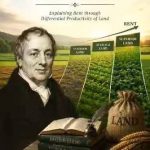
Land: land refers to all natural resources which are free gift of nature. It includes soil, rivers, waters, forests, mountains, mines, deserts, air, sun etc. Features/characteristics of land: Limited in…
Lionel Robbins defines economics in terms of scarcity and choices. Scarcity refers to limited resources or scarce resources at our disposal. But the human wants and needs are unlimited and…
The welfare definition of economics was given by the leader of Neo-classical economists Alfred Marshall. He published the book “principle of Economics” in 1890 AD and defined economics in terms…
Wealth definition of economics is given by Adam Smith. Adam Smith published a book entitled ‘ An Enquiry into the Nature and Causes of Wealth of Nations’ in 1776- popularly…
It is a social science that studies the economic problems of society. It studies the relationship between scarce resources and their alternative uses. It deals with how the limited(scarce) resources…
Monetary Policy is the exercise of the central bank to control over money supply in order to achieve the objective of price stability, forex stability, interest rate stability and overall…